
A species archive for New Zealand’s tiny land snails
Malacologists Frank Climo and Karin Mahlfeld had one species factsheet online. I turned their site into a searchable archive of 82 native snail species, each record built from published, credited sources, with a plain form so they can add and update species themselves.
- 1 to 82
- species online, from one factsheet to a full archive
- 6
- snail families, from Charopidae to Otinidae
- 3
- ways to browse: family, threat status and who described it
- Every
- record lists the published sources it was built from
The people behind it
Most of New Zealand’s native land snails are a few millimetres across, and nearly all of them live nowhere else. Frank Climo and Karin Mahlfeld have spent decades describing them: Frank since the late 1960s, and Karin as the Department of Conservation’s land snails ranger in Wellington and lead author of the 2012 national threat assessment. In 2025, with David Roscoe, they described sixteen new species.
Their website, the New Zealand Mollusca Biodiversity Archive, is where that work is meant to be shared.
Where it started
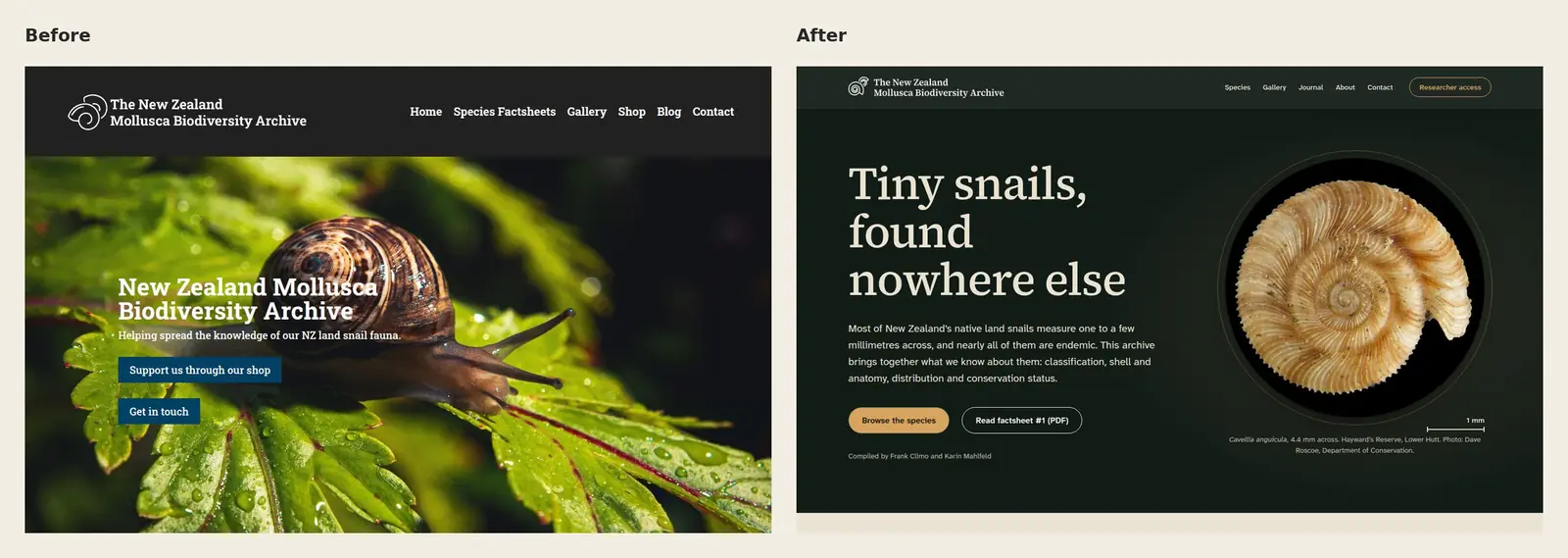
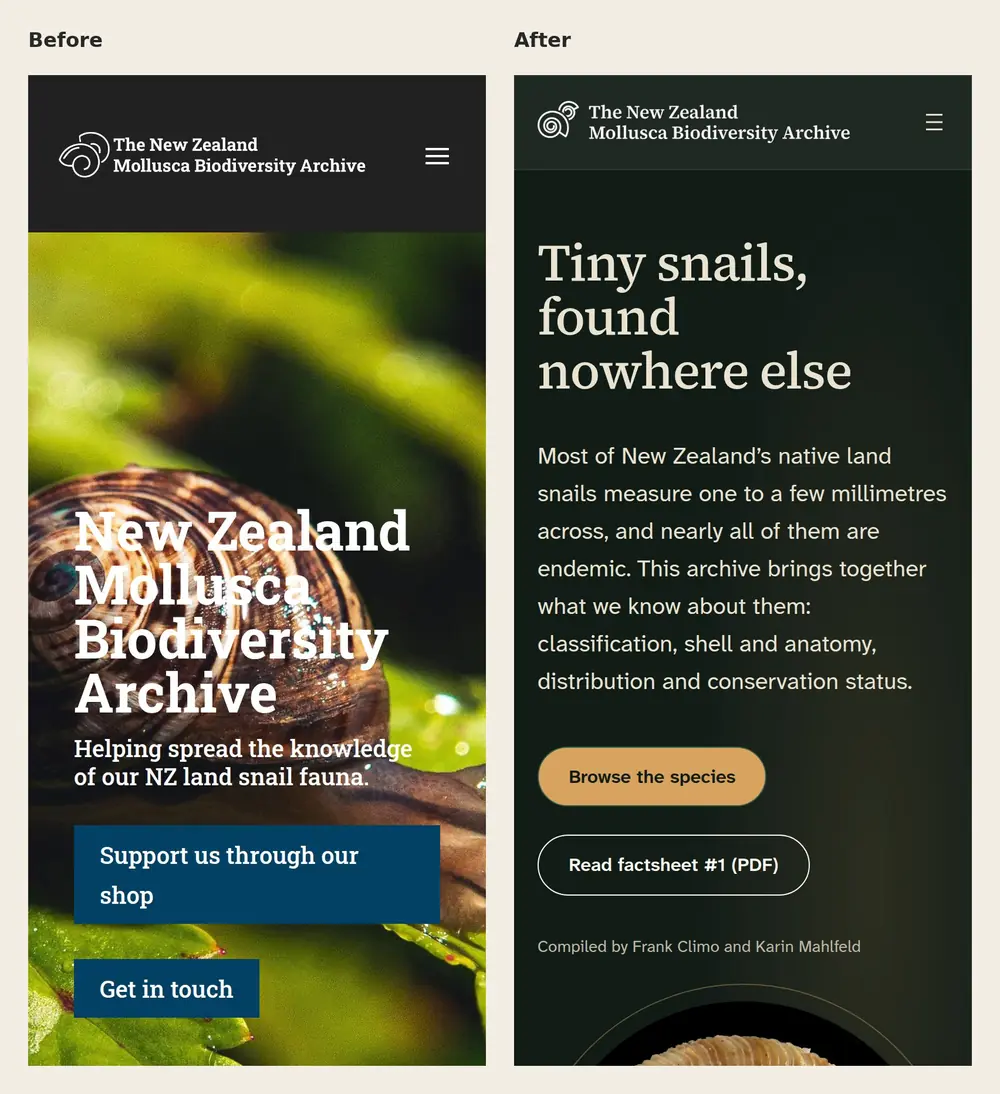
The first site got the archive online. It was built on a general purpose page builder theme with a shop attached, and its homepage led with “Support us through our shop” over a large snail photograph. The species section held a single factsheet, listed twice. Researchers had no way to browse by family or threat status, and adding a species meant building a page by hand.
Before and after
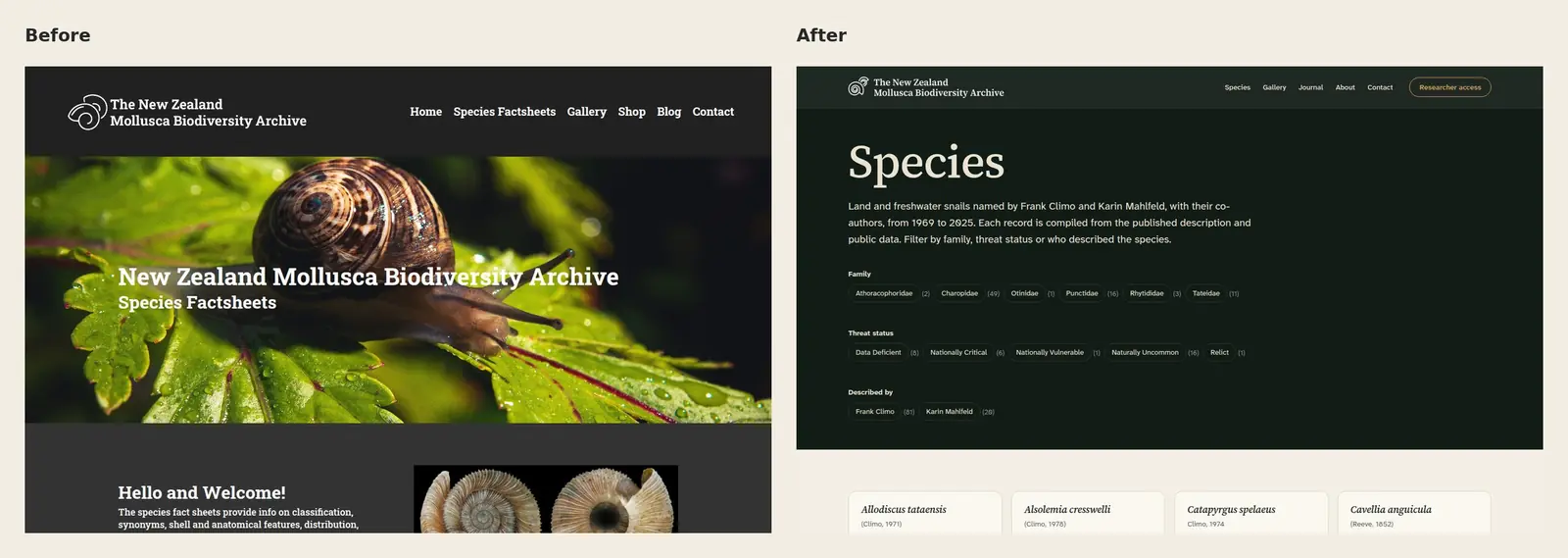
The old screenshots come from the Internet Archive’s capture of May 2024, which is how visitors saw the site. The new ones were taken on 18 November 2026.
What I built
A real species database
Every species is now a record, not a page. I imported 82 of them: the 81 land and freshwater species whose names Frank and Karin published, plus the archive’s own factsheet species, Cavellia anguicula. Visitors can filter by family, threat status or who described the species, and each record lists its sources: the GBIF taxonomy, Plazi treatments of the 2025 paper, and the New Zealand Threat Classification System. Where a fact couldn’t be confirmed, the record says so rather than guessing.
Editing without a developer
Frank and Karin are scientists, not web editors, so species aren’t edited in a page builder. Each one has a plain form with a labelled box per fact: shell, distribution, habitat, anatomy, type material and threat status. Empty boxes are left off the page, the species name is italicised automatically, and the layout can’t be broken from the form.
Specimens at their real scale
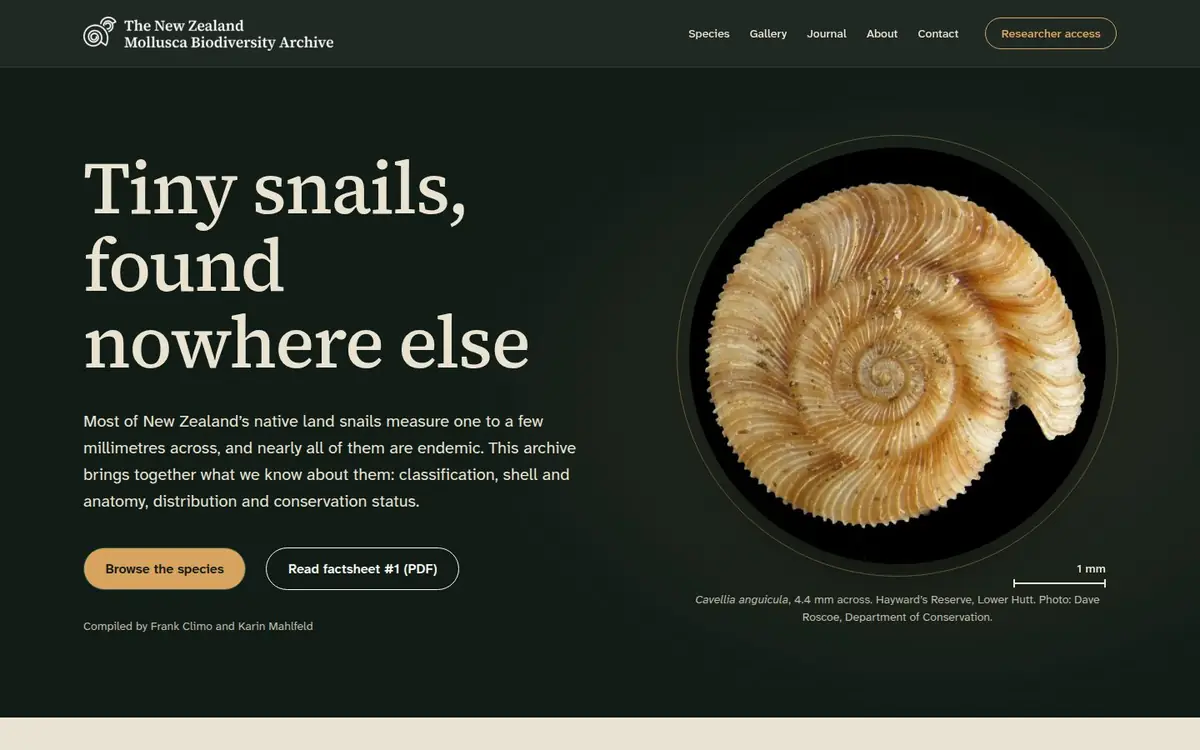
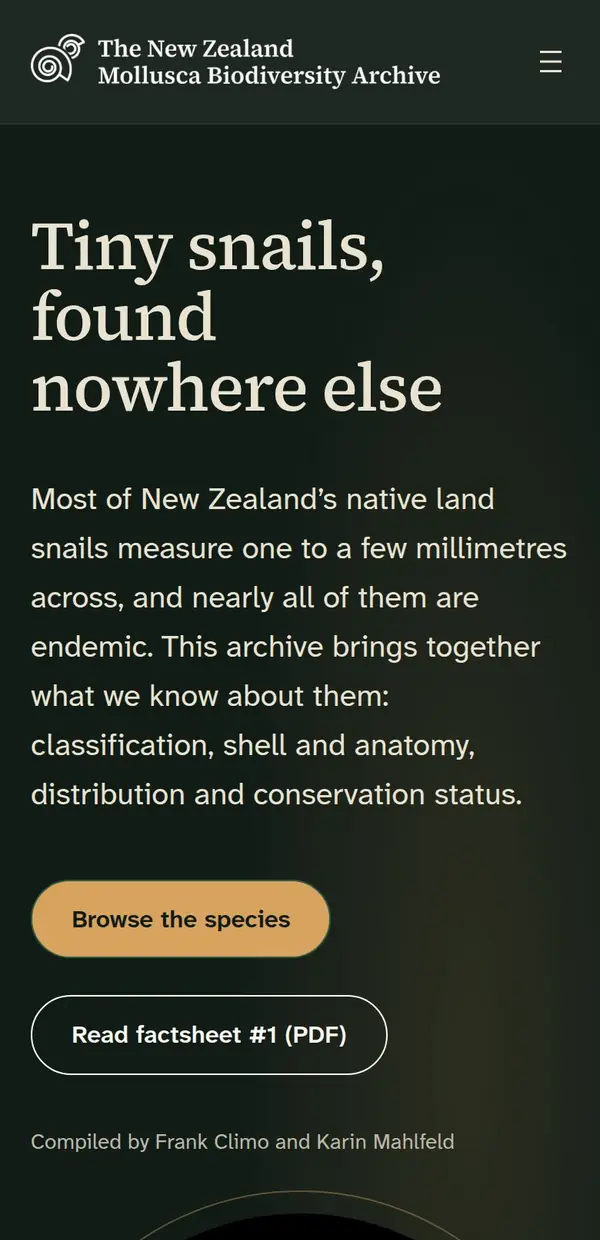
The homepage opens on one of Dave Roscoe’s specimen photographs with a 1 mm scale bar beside it, so the first thing a visitor learns is how small these animals are. Body text is set in Atkinson Hyperlegible Next, a typeface designed for readers with low vision.
A logo that coils the right way
The old mark’s shells spiralled anticlockwise, which on a real snail means a left-handed shell. Nearly all New Zealand land snails are right-handed, so I redrew the mark with both shells coiling the correct way. The people who use this archive would notice.
A gallery connected to the science
Every image in the media library can be linked to a species. A linked image shows “About Cavellia anguicula” under it wherever it appears, and turns up on that species’ page automatically.
Nothing lost along the way
Old factsheet and blog addresses redirect to their new homes, so existing links and bookmarks still work.
The archive up close
A species record
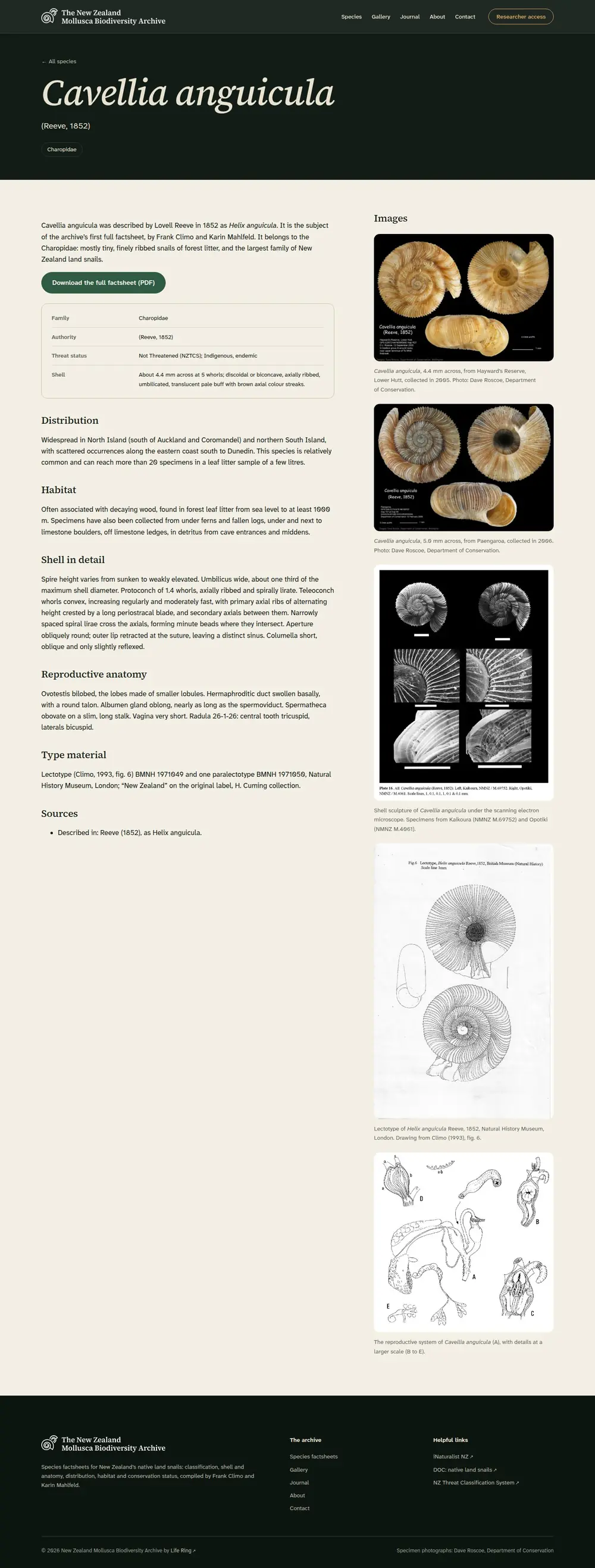
Each species record is built from a plain form, with its images alongside. Scroll inside the frame to see the whole record.
The gallery
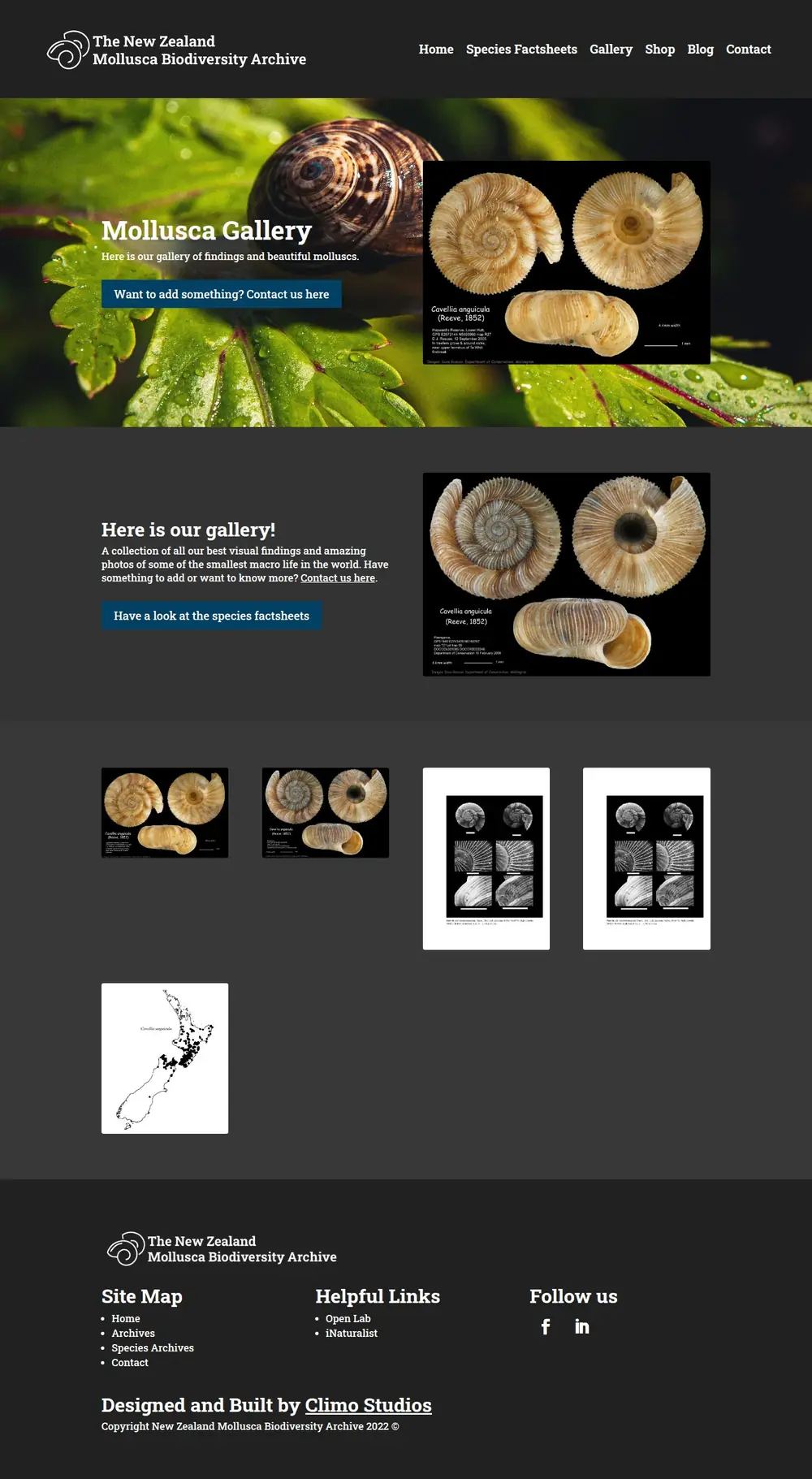
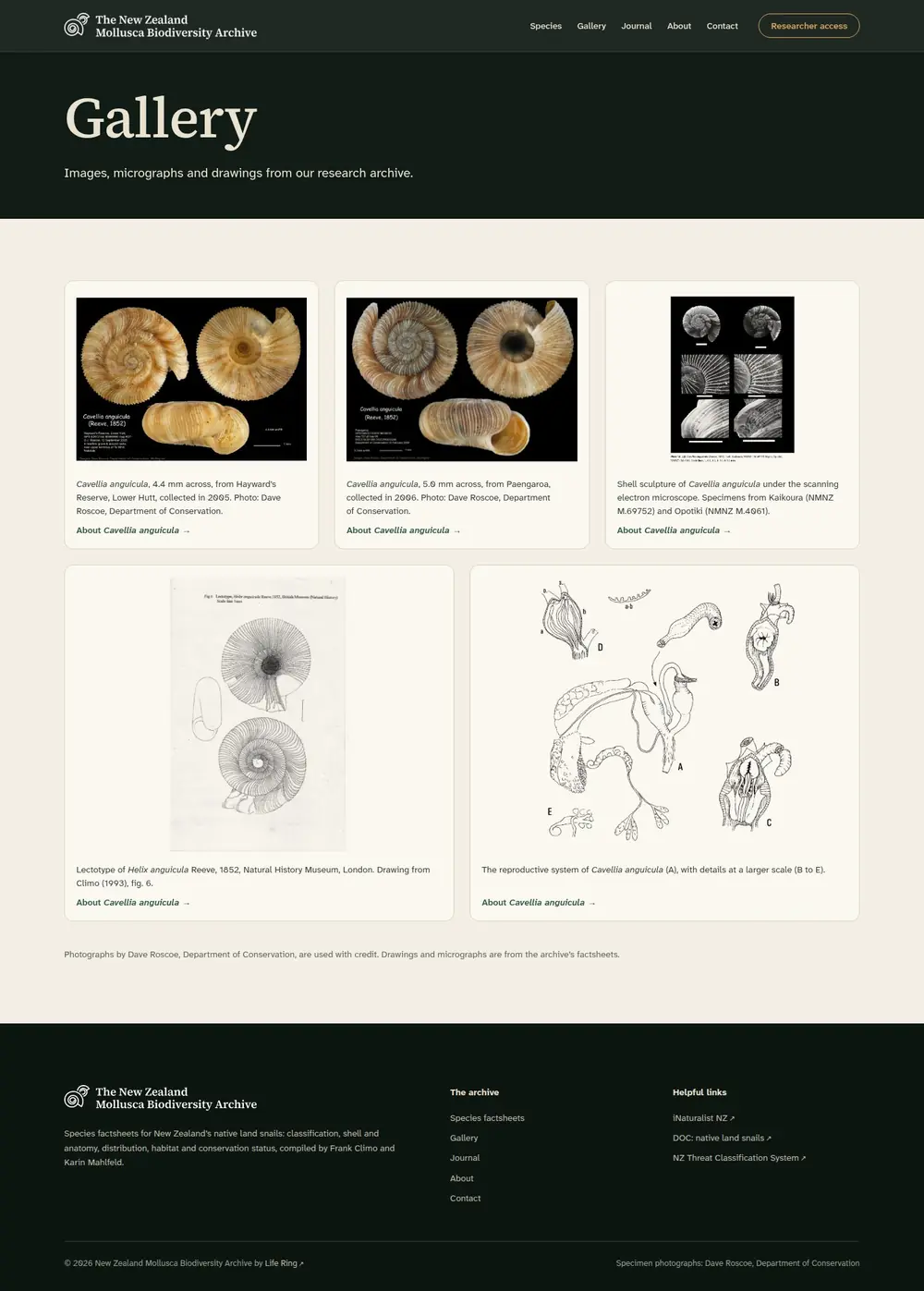
Gallery images now link straight to their species.
The result
| Before | After | |
|---|---|---|
| Species online | 1 factsheet | 82 species records |
| Ways to browse | One list | Family, threat status, described by |
| Sources per species | Not listed | On every record |
| Adding a species | Build a page by hand | Fill in a form |
| Images linked to species | No | Yes, automatically |
Under the hood
- A native WordPress block theme with no page builder, so pages are light and every brand decision lives in one settings file
- Images served as AVIF
- External links and PDFs open in a new tab automatically, with a note for screen reader users
- A contact form styled to match the site, with spam protection
Specimen photographs on the archive and in these screenshots are by Dave Roscoe, Department of Conservation.
Got a site that should do more?
Start with a free, written audit of your current site, or tell me what you need and I’ll come back with an honest read on fit and cost.